
How to market ready-made clothes
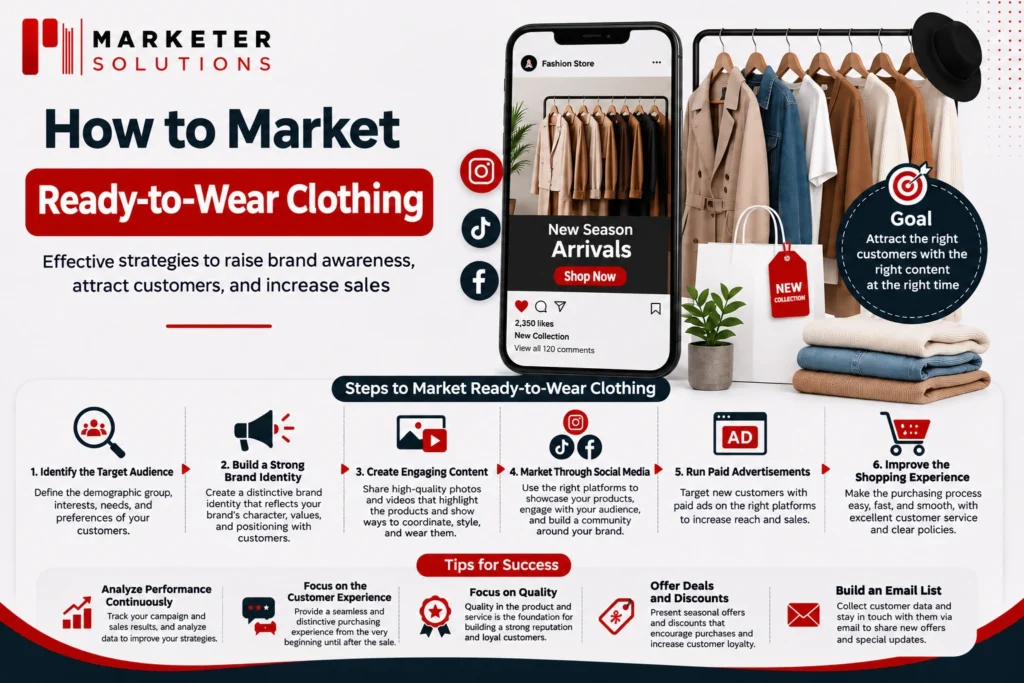
Knowing how to market ready-to-wear clothing is key to a brand’s growth. With the digital transformation the region is currently experiencing, it will take building digital marketing strategies Integrated, which can combine quality and a strong digital presence to reach the target audience that is always looking for excellence, and to achieve these goals, you must cooperate with leading companies in this field, such as Marketer, which works to provide innovative solutions that guarantee the brand’s professionalism and seeks with it to increase its market share through a set of accurate analytical tools and carefully directed advertising campaigns to ensure higher profitability. How to market ready-made clothes in Saudi Arabia? To achieve success in the ready-made clothing marketing market in Saudi Arabia, a well-thought-out strategy must be followed, which we explain as follows: A deep understanding of the culture of the consumer who is looking for the piece that combines culture and style. Providing them with an easy and smooth online purchasing experience that guarantees them complete privacy. Use E-commerce For sustainable growth and overcoming geographical obstacles for stores. Using specialized companies such as Marketer to build an advanced selling platform that complies with SEO standards. Accurate analysis of buyers’ behavior to help improve offers and discounts and increase conversion rates. How do you determine the target audience and competitive advantage for a clothing brand? Once we understand how to market ready-made clothing, we can focus on determining the target audience and the competitive advantage of any clothing brand, as this is done through good and carefully prepared planning, and this can be summarized in the following points: Study the age group, personal interests, and purchasing power of customers to ensure offering products that meet their needs. Creating a competitive advantage that helps provide additional value not available to competitors, such as using luxurious quality and materials or providing exclusive designs. Focusing on providing exceptional customer service makes the in-store shopping experience unique. Helping the customer pay using more than one different payment method in an easy and smooth way that helps him repeat the purchase again. The best ready-made clothing marketing strategies After learning how to market ready-made clothing, it becomes clear that success lies in diversification Marketing methods that you follow in marketing And linking them in an integrated manner to achieve the maximum return on investment. The following table shows a detailed comparison between the most important strategies currently used: Strategy The purpose of its use Channel used Visual content marketing Display product details and increase brand awareness Instagram and TikTok Paid ads Achieving quick and direct sales Facebook and Instagram Search engine optimization Attracting new permanent customers to the store Product pages and website blogs Marketing and influencers Building trust and credibility for the public Celebrities and fashionistas What are the best marketing channels for selling clothes? How to market ready-made clothing depends on choosing the appropriate channel in which the target audience is located to ensure comprehensive and effective coverage. Therefore, we must focus on a group of marketing channels that achieve the highest interaction rates. We mention some of them: platform InstagramIt is considered the first channel for displaying clothes thanks to its visual nature, as it allows the publication of high-quality photos and videos. TikTok ads: It is a good way to communicate with different age groups by publishing creative content that displays clothes in a lively and interactive way that attracts attention. Snap ads Chat: It is very popular in Saudi Arabia and is ideal for launching short, influential advertising campaigns targeting specific geographical areas. Online stores: It is a main base that gives full control over customer data, buying and selling processes, and efficient and professional inventory management. Marketing via WhatsApp or mail: Effective tools that help target existing customers and send them offers periodically to encourage them to buy again. How do you create marketing content that sells clothes? In the context of learning how to market ready-made clothes, it stands out Content marketing strategies Marketing is something that requires creativity and a deep understanding of the target audience, as it must focus on a set of points to convert the viewer into a buyer, which are as follows: Visual Storytelling: Not just displaying the clothing but also showcasing the lifestyle that these clothing can provide to the customer on multiple occasions. Highlighting the quality of details: Using modern and close-up photography techniques to show the quality of materials and color consistency to enhance customer confidence in the product. Educational content: Providing tips on how to coordinate different clothing pieces with each other to create a variety of looks, which increases the value of the product. Using live videos: in which the clothes are shown to the models, it gives a clear idea of the flow of the piece and the available sizes. Testimonials from real customers: Publishing opinions and photos of previous customers and what they wear gives stronger credibility and encourages others to have this experience. How to use influencers and customer content in clothing marketing? Cooperation with influencers is considered a strong bridge to quickly build trust with the target audience, especially when public figures are chosen that are in line with the identity in the brand. Here, the role of e-marketing companies such as Marketer contributes to nominating influencers who have a large and real fan base because encouraging the customer to photograph purchases and share them about the brand creates honest and spontaneous content that is superior to traditional advertisements. Providing rewards to customers who share their experiences will increase awareness of the brand, ensuring a wider and greater dissemination of the products. How to optimize your clothing store and product pages to increase sales? After knowing how to market ready-made clothing, we can focus on the necessity of improving an online clothing store, which is considered one of the important strategies that requires extensive attention to all technical details. This can be achieved by following the following steps: Loading images and store pages:
How to market beauty products
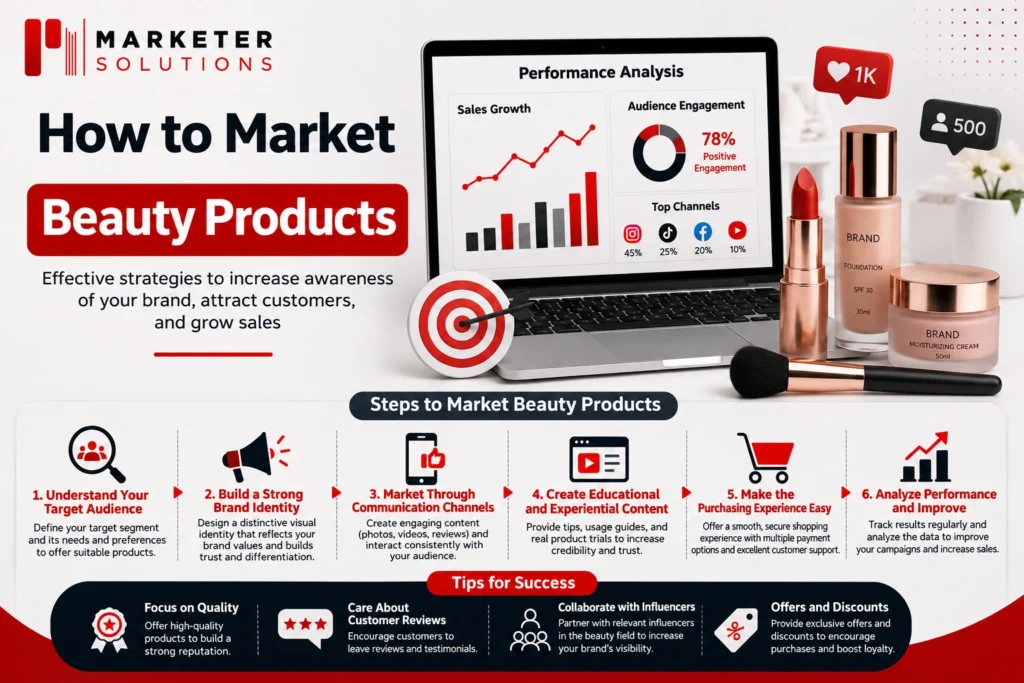
How to market beauty products begins with a clear plan developed based on the brand’s goals and customer requirements. Lowering prices or relying on displaying products is no longer enough to attract attention. Rather, building a distinctive symbolic image for the brand, providing convincing content, and reaching the right audience has become one of the most important factors for success. Here comes the role of specialized marketing companies such as Marketer Solutions, which is The best digital marketing company in Riyadh It determines the best channels for marketing, studies competitors, launches promotional campaigns, and improves the brand’s digital presence by following a comprehensive and effective strategy. How to market beauty products in Saudi Arabia? An effective strategy on how to market beauty products in the Kingdom can be built through a set of interconnected steps as follows: Understanding the market and audience: The segment to be addressed must be determined in terms of age, purchasing power, and interests. Visual identity design Clear: The visual identity must reflect the brand’s personality and help distinguish it among competitors. Focus on visual content: Beauty products rely heavily on the visual experience, which is why before-and-after content and usage videos contribute to clarifying the product and building trust. Integrating organic and paid marketing: SEO, content, interaction, and advertising must be combined in order to reach your target customers. Leverage customer experiences: Videos, photos, and reviews provided by customers add another element of credibility that is difficult to achieve with traditional media content. How do you determine the target audience and competitive advantage for beauty products? It is possible to determine the target audience in how to market beauty products with Marketer Solutions by following some steps as follows: Demographic factors: age, gender, education, income, marital status, and geographical location. The requirements of adolescents are different from those of older age groups. Values and motivations: Knowing what the customer cares about helps craft a promotional message that is more relevant to their needs. Lifestyle and interests: Some customers may be interested in sustainable or natural products, while others are looking for multi-use products or the latest makeup trends. Actual customer data: It is possible to make use of surveys, sales data and analytics Social media platforms To identify the products that are of greatest interest to the target audience. The best beauty product marketing strategies The best strategies for marketing beauty products in the Kingdom, which are followed by Marketer Solutions, are as follows: Educational content: Providing lessons on how to use and care routine, and answering the most common questions contributes to educating the customer instead of offering direct sales messages. Search engine optimizationThe appearance of a beauty store in search results contributes to increasing the chances of reaching target customers who are already searching for products or solutions that relate to their needs. Content marketing strategy Visual: It is possible to use before and after videos, order openings, product trials and GRWM, to show the product in a real context of use. UGC: Customer experiences can be turned into shareable videos, images, and reviews to enhance credibility and increase engagement. Influencer marketing: The content creator is selected based on how their audience matches the brand’s audience, which helps make the collaboration more relevant to already interested customers. Sponsored ads: It allows quick access to different, specific segments of targeted customers with the ability to track performance indicators such as conversions, clicks, cost of customer acquisition, as well as return on investment. Retargeting: It is possible to target ads to people who have already interacted with the store or products and have not completed the purchase process to increase the chances of conversion. What are the best marketing channels for beauty products? How to market beauty products includes the best reliable channels, which are as follows: Snap ads Chat: Suitable for products that require quick, repetitive visual display. It is possible to use the content of daily stories, paid ads, or interactive filters. TikTok adsSuitable for short, entertaining and educational content, examples of which include opening requests and content that answers questions and misconceptions related to products. Email and WhatsApp: Useful for reselling, sending offers, reminding of abandoned baskets, and following up with customers after purchase. Search engines: Suitable for customers searching for a specific product or solution, and therefore represents an important channel for all stores that want to build continuous visits through search results. Instagram: Suitable for displaying the visual identity of brands using images, reels, and interactive educational content. How do you create marketing content that convinces the customer to buy beauty products? How to market beauty products includes creating marketing content that persuades the customer to buy the products and explains how they can be used and their benefits through the following: Education: The mechanism of use, the appropriate routine, and how the product can be chosen according to the client’s needs must be explained. Showing the result: You can use before and after videos, as well as show the product during use, avoiding exaggeration of the results. Answering objections: Frequently asked questions can be turned into content that emphasizes to the customer what they need to understand or know before purchasing. Highlighting value: Instead of simply explaining the product’s components and characteristics, it can be explained how those characteristics relate to customer requirements. Show experience: You can present order opening content, usage experiences, and packaging to give a closer picture of the real customer experience. Add a clear invitation: The customer must know the next step, whether visiting the product page, taking advantage of a specific offer, or ordering the product. Influencer marketing for beauty products How to market beauty products includes marketing through influencers, and the best influencer must be chosen to achieve the goal of the advertisement through the following: Audience screening: If there is an influencer who has a smaller audience but is really interested in grooming and makeup, it may be a better fit than a huge account with an audience that is not
Digital reputation management strategies
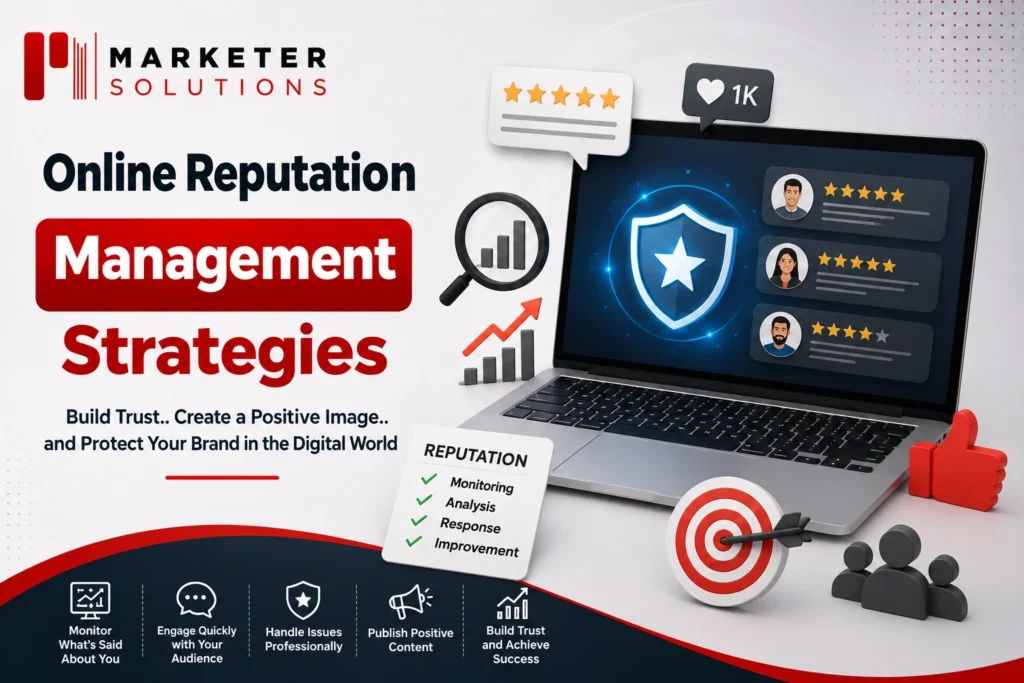
Digital reputation management strategies play a major role in building a professional and reliable image of the brand in front of target customers. The reputation of any company is no longer linked only to what it offers, but rather to the mechanism of its appearance and interaction with the public through the Internet. Therefore, different institutions and companies need comprehensive strategies that monitor what is presented about them and deal very intelligently with various comments and evaluations, and Marketer Solutions helps you, which is… The best digital marketing company in Riyadh To enhance your identity and manage your digital reputation professionally through customized solutions and strategies that achieve your desired goals and enhance your presence in the Saudi market as quickly as possible. What are the most important digital reputation management strategies? Digital Reputation Management or Online Reputation Management is not just a response to comments, but rather a comprehensive system of a set of strategies that come together to build a positive image of the brand as follows: Improve customer experience Every ORM strategy starts from within, as a good customer experience is the first source of positive reviews, while any defect in the service turns into a widespread negative comment, which is why customer experience is supposed to be the starting point before considering any technology or digital tool. Promoting positive presence Publishing SEO-compliant content helps highlight the company’s achievements, values, and goals and helps it dominate the search results associated with its name and push any negative content to less visible results. Continuous monitoring and social listening Following up on everything the public is talking about about the brand through various platforms, which contributes to rapid intervention before any remark or comment turns into a major crisis. Building trust A quick, honest response to customer questions and their participation in the decisions made enhances their experience and creates a long-term relationship with them based on trust and transparency. How to build a digital reputation management strategy for your company? Building digital reputation management strategies requires a clear methodology that begins with an understanding of the current situation and ends with an implementable plan as follows: Analyze the current brand position: You must collect all available information about the current reputation, represented by ratings on Google Reviews, social media comments, and what appears in the search results when you type the company name. Setting goals: Clear, measurable goals should be set, such as increasing the average rating on Google Business Profile Reducing the time to respond to complaints and setting accurate performance indicators to monitor progress. Develop a content plan: A schedule must be set to continuously publish positive content, in addition to a specific protocol for the mechanism of responding to comments, whether positive or negative. How do you monitor your brand’s online reputation? Continuous monitoring of a brand’s reputation on the Internet detects problems before they escalate, especially if tools are used to help with this, such as the following: Brand Mentions and Review Monitoring Tools These tools help track every mention of the company’s name across the Internet, whether in forums, articles, or communication platforms, so that you are always informed of the latest things being said about you. Sentiment Analysis You must understand the nature of mention of your brand name, whether positive or negative, because identifying and analyzing sentiment helps you accurately know the general trend of the public’s opinion of your brand. How do you deal with negative ratings and comments? The way you deal with criticism determines your image before the target audience more than the criticism itself. Therefore, you must deal according to the following basis: Dealing with real negative reviews Acknowledge the problem, apologize sincerely, and then offer as practical a solution as possible to show other customers that the company actually cares about addressing errors rather than letting them go or ignoring them. Dealing with fake or infringing reviews If you spot fake reviews or that violate the policies followed on social media platforms, you can report them officially through the platform’s tools themselves, while documenting the matter with evidence proving their inaccuracy before submitting the request. How do you protect your brand reputation in Google search results? Protecting your brand reputation in Google search results is a key part of any digital speed management strategies because it is the first thing a potential customer sees about you, and you can do the following to achieve this goal: Search engine optimization: Publish useful, regular, high-quality content on the website and social media platforms, targeting the brand name to rank high in search results instead of negative content. Manage Google Business Profile: Make sure the file data is complete and constantly updated, because it is often the first thing a customer sees when searching for the company name and its accuracy immediately enhances their trust. How to manage digital crises and protect the company’s reputation You can manage digital crises, which can start from a single comment and spread in a few hours through the following: Rapid response when a crisis arises: Assess the extent of the problem, then identify a team to respond. Avoid deleting comments without a clear response to them, as this increases suspicions rather than allays them. Official communication with the public: You must issue a clear and official statement confirming the company’s position with continuous updates until the crisis ends, because silence in those moments is often interpreted as evading responsibility. How do you measure the success of a digital reputation management strategy? You can know whether your efforts are bearing fruit or not through digital reputation management strategies by following some of the following indicators: Average rating on Google Reviews. Number and speed of responses to public complaints. Ratio of positive comments compared to negative ones through sentiment analysis. The level of customer confidence, which is measured through periodic questionnaires. Positive page ranking in Google search results when searching for the company name. When does your company need a specialized digital reputation
Bounce rate on websites

The bounce rate on websites is one of the important metrics that business owners rely on to know the extent of visitors’ interaction with the content of their sites. When this indicator increases, it is clear evidence of the presence of a defect, whether in the design of the user interface, the quality of the content, or the speed of loading pages, which requires rapid intervention to address it before it negatively affects the site’s ranking in search engines and reduces the chances of conversion. This is why he is keen to SEO Those at our company, Marketer Solutions, carefully study this rate and use appropriate analysis tools to understand visitors’ behavior and improve the performance of your site. What is the bounce rate on websites and how is it calculated? The bounce rate on websites is expressed as the percentage of visitors who are on one page of the website and then leave it without interacting with any other element of it, whether by moving to another page or performing a measurable action. How is the bounce rate calculated? The bounce rate on websites in GA4 is calculated using a specific formula, which is: Bounce rate = 100% – interaction rate. For example, if your site’s interaction rate is 65%, then the bounce rate is 35%, but 35% is not considered a bad or excellent rate for all websites, because the interpretation of that number depends mainly on the type of page, its goal, and the source of visits. What does bounce rate mean in practice? The meaning of bounce rate on websites can be clarified practically by assuming that someone entered an article answering a specific question, read the entire answer, then closed the page in a way that did not require moving to another page. On the other hand, if the user entered a service page and did not find the information he was looking for or could not understand the next step and then left without interacting, this may indicate the presence of a problem that requires analysis. Therefore, the bounce rate should not be treated as a separate number, but rather an indicator within a set of information or data that explains the user’s behavior and the conversion journey. Does a high bounce rate mean there is a problem with the site? It does not necessarily mean that there is a problem if the bounce rate is high on websites because the relative meaning varies according to the purpose of the page, and the increase may be normal on some informational pages, especially when the user gets a direct answer. In contrast, if the high bounce rate is accompanied by a decrease in the duration of stay on the page and in the conversion rate, this requires stopping and checking. The basic criterion here is linking the bounce rate to the goal of the page. For example, a landing page designated for an advertising campaign must push the visitor to take a specific action and a high bounce rate means that there is a gap between the visitor’s expectations and the content of the page. Therefore, it is important to look at the full context, represented by the type of page, the source of visits, and its desired goal, rather than relying on the rate as an absolute indicator of the bad or good of the site. The most important reasons for the high bounce rate on websites It is possible that the bounce rate on websites may increase due to a problem in the design, content, technical performance, or something else, as follows: Content mismatch with Search Intent The user enters the website with a clear goal, and when he does not find it quickly, he is more likely to leave without interacting. If he is looking for the price of a service, the page must provide data or information that helps understand the price and the factors affecting it. If he is looking for an explanation, the page should not be just a long advertisement. Slow page loading The longer the page loads or the main content appears, the more likely the visitor is to leave the page before interacting with it. Therefore, performance must be examined using Core Web Vitals indicators, which measure a group of key aspects of the user experience, such as loading speed, visual stability, and responsiveness. The title does not reflect the content of the page If the title promises the visitor a specific answer that he does not find on the page, he will leave quickly. Therefore, it is important to achieve a clear match between the title, content, description, keywords, and the actual goal of the page. Poor UX The site may have good content, but its display mechanism makes it difficult to access. The most common problems include crowded pages, difficulty navigating between sections, poor clarity of buttons, the presence of distracting elements, difficulty reading from a phone, and lack of clarity about the next step. Poor internal linking If the visitor finishes reading the page without finding relevant content, an appropriate next step, or a service, he loses the opportunity to stay on the site. Good internal linking helps direct the user to relevant pages and give him a natural path to complete his journey. Annoying ads and popups Windows that cover information or content in general once a visitor enters, or a large number of promotional elements, may make access to useful content more difficult, especially on phones. Therefore, the use of these elements must be moderate, while maintaining the clarity and ease of access to the main content. Target inappropriate traffic The problem could be the quality of visits and not the page. Advertising campaigns that target a large, inappropriate audience may bring a lot of visits but do not achieve conversions or interaction. Therefore, the bounce rate must be analyzed according to the source of the visit, the campaign, andDetermine the target audience in advertising campaigns And not entirely based
E-marketing budget
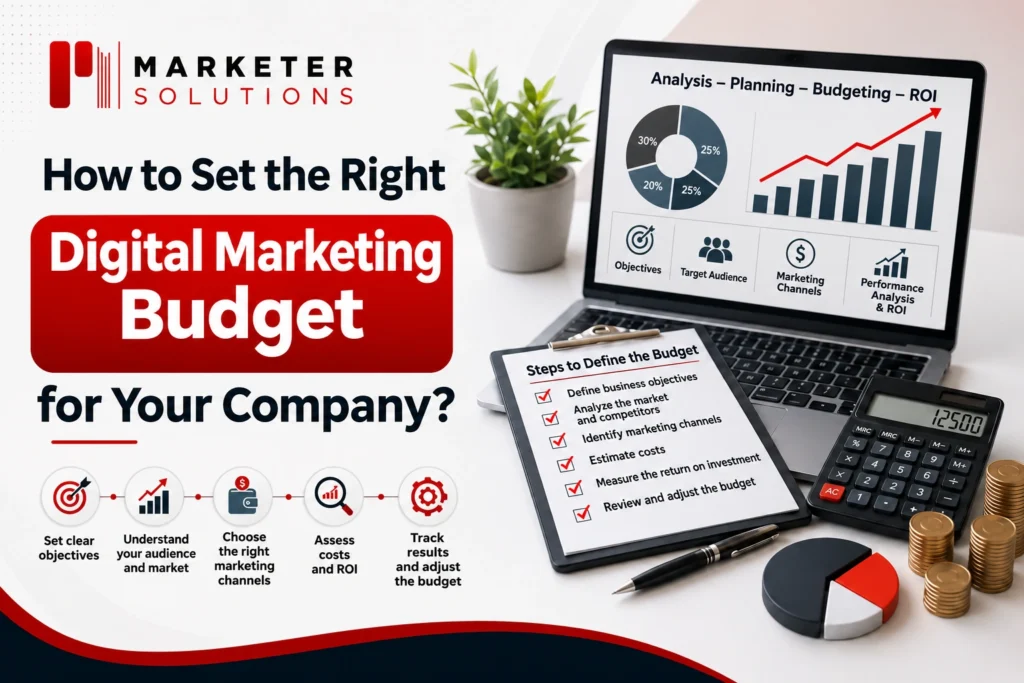
Determining the e-marketing budget is the basis on which successful companies build their marketing plans to reach the target audience and achieve their goals. When dealing with distinguished companies specialized in e-marketing such as Marketer, they ensure that resources are directed in the right place through a well-thought-out financial plan, because the growth of activity depends on a balanced and accurate strategy that combines paid campaigns and digital assets in the long term to achieve the highest return on investment. How do you determine the appropriate e-marketing budget for your company? “Determining the digital marketing budget is an essential step that requires a deep study of the company’s capabilities and future ambitions, in order to build a strong competitive advantage within the market. Here, Marketer Solutions helps companies determine the budget and direct digital marketing strategies towards the right track, ensuring that financial resources are not wasted in useless channels. We will explain in detail how to determine this budget effectively through the following points: Determine the budget as a percentage of revenue This method depends on allocating a percentage of the total expected revenues of the existing activity, ranging from 5 to 15%, to large companies. As for emerging companies and new projects that seek to penetrate the market directly, this percentage may rise to exceed 20% in order to build sufficient awareness of the brand. Determine the budget based on sales goals This strategy depends on determining the required sales volume and then reflecting that on the marketing costs to achieve the goals accurately. This is done by clarifying the number of the target audience and the expected conversion rates to estimate the volume of operational and advertising spending. Determine budget based on customer acquisition cost and expected revenue Advanced companies rely on matching the cost of customer acquisition with the lifetime value of the customer to ensure profitability. If the value generated from the customer exceeds the cost of attracting him, then the abundant use of financial resources becomes the most profitable investment decision for the company. What factors determine the size of the marketing budget? The volume of marketing spending is affected by many factors and variables that vary according to the nature of the activity and the size of the market. Hence the importance of cooperation with The best digital marketing company in Saudi Arabia Such as Marketer Solutions, which gives you a comprehensive analytical study that shows how to manage your marketing budget with the highest efficiency and best return. We will review with you the most important of these factors in the following lines: Company size and growth stage Start-up companies initially need a huge budget to introduce products and build a customer base, while large companies are satisfied with a budget that focuses more on maintaining market share and maintaining customer loyalty at the present time. Sales and marketing goals The desire to expand geographically and launch new products requires huge financial flows to support continuous and intensive advertising campaigns. The more the company aims to build market dominance, the more it needs to raise the level of marketing spending. The nature of activity and competition in the market Marketing costs vary from one sector to another in a crowded market such as e-commerce and real estate, which need more financial resources to stand out. Therefore, the nature of competitors must be studied well and an adequate budget must be determined. The cost of reaching the target customer The company’s budget is affected by the cost of appearing on different platforms or by the accuracy of social and geographical targeting, as choosing the appropriate category reduces the cost of advertising and increases the efficiency of investment in campaigns. How do you distribute the e-marketing budget? Distributing the marketing budget is a challenge for business owners who want to diversify and rely on more than one marketing channel, and for this they need to build a flexible and balanced marketing plan that combines quick results and long-term digital access while at the same time distributing the digital marketing budget in accordance with the set goals. In the following points we will explain in more detail about this matter: Paid ads Obsess Sponsored ads On platforms such as Google and Tok Tok, they receive the largest portion of the digital marketing budget due to their accuracy and speed of results, as these campaigns ensure a rapid and immediate flow of many interested customers, so managing them with high professionalism is a prerequisite for reducing the cost of conversion. SEO The investment is considered in determining the marketing budget related to Search engine optimization A strategic choice for building a strong and sustainable digital brand, as investing in this ensures the top spot in search results, which reduces reliance on paid advertising and helps reduce marketing costs in the long term. Social media and content marketing This item includes the costs of producing designs, visual materials, and writing content to attract and build target groups Business identity Powerful, as useful and valuable content contributes to enhancing customer confidence and transforming them from mere visitors on the site to browse products to permanent customers who need the company’s products and services. Marketing, analysis and agency tools Digital tasks cannot be accomplished without allocating a portion of the budget to subscriptions to analytical platforms, technical tools, and artificial intelligence. The marketing budget calculation must also include the fees of partners such as Marketer to develop and manage campaigns with high professionalism. The difference between marketing budget and advertising budget It is difficult to differentiate between the marketing budget and the advertising budget, and here the role of Marketer is highlighted in that it helps to clarify the fundamental differences accurately. The advertising budget represents the amounts paid to digital platforms, while the marketing budget is the comprehensive umbrella for all operational activities and operations, so we will review in the following table the difference in detail: Comparison Advertising budget Marketing budget Definition Allocating funds to advertising
How to increase pharmacy sales
How to increase pharmacy sales begins with having a clear marketing vision that goes beyond traditional methods to attract customers to build a lasting relationship with them and turn their visits into repeated purchases. With the diversity and diversity of pharmacies and the intensification of competition in the Saudi market, the need has become greater for a thoughtful mechanism and strategy that accurately identifies the target audience, understands customer behavior, and provides the right offers and content at the right time. Here the value appears. Marketer Solutions company Which helps pharmacies build a strong presence, enhance their electronic visibility, and reach potential customers through the channels that most influence them, which helps support sales growth and enhance the pharmacy’s position in the market. How to increase pharmacy sales in Saudi Arabia? Before talking about any marketing tool, it must be understood that pharmacy sales are built on three basic axes, and any successful marketing plan with Digital marketing agency It must be targeted at one or more of these axes, and any marketing effort that does not serve one of them often becomes a waste of time and budget. Increase the number of clients The first axis is to attract new customers who have not previously dealt with the pharmacy. This is achieved by improving visibility in local search results, referrals from existing customers, and sponsored advertisements. Pharmacies that rely on consumers’ random traffic in front of their site lose many opportunities, because the majority of those searching for a specific product or medication search first through Google and Google Maps before they actually go to one of the pharmacies located near them. Increase the average bill value The second axis is not related to attracting new customers, but it helps increase the value of the purchases made by the current customer. For example, if a customer buys a pain reliever, he can also leave the pharmacy with a topical gel or an appropriate nutritional supplement if the matter is suggested to him correctly, which causes the average bill to rise by a percentage that may make a long-term difference in monthly revenues without having to deal with a single additional customer. Increase repeat purchase rate The third axis in this process is to increase the number of times the customer visits the pharmacy, as he must return there every two weeks or a month. This type of axis is the cheapest in cost and has the highest return on increasing pharmacy sales, because keeping an existing customer does not cost a lot of money compared to acquiring a new customer, and this is mostly achieved through loyalty programs and continuous communication through WhatsApp and text messages. The best strategies for increasing pharmacy sales After clarifying the three basic axes of how to increase pharmacy sales, the next step is choosing the appropriate tools that serve these axes effectively, and the following are the most prominent: digital marketing strategies Proven in the Saudi market from our company Marketer Solutions: Local marketing and visibility on Google Maps Most pharmacy customers search with different terms, such as 24-hour pharmacy or pharmacy near me in their area. To improve the appearance of your pharmacy with these results, you must do the following: Create and update a Google Business Profile with accurate information about the pharmacy address, working hours, and mobile number. Posting modern, clear pictures of the pharmacy from the outside and inside. Encourage customers who are satisfied with the pharmacy to leave reviews, and all reviews must be answered, whether negative or positive. Ensure that the pharmacy name and address match all platforms, delivery applications, Google Maps, social networking sites, and others. Social media marketing Platforms such as Snapchat, Instagram, and TikTok are suitable for building a relationship of trust with customers through educational content that includes instructions for the correct use of certain products or health tips to follow the season, such as seasonal allergies and colds, because this type of content builds trust in the pharmacist as a reliable reference, which is later reflected in the purchase decision. Google Ads and Sponsored Ads Sponsored ads on Google and Google Maps give the pharmacy immediate exposure in local search results, and are considered very useful for new pharmacies that have not yet achieved the appropriate natural ranking for them. It is always recommended to set a specific daily budget and target a specific geographic range related to the pharmacy’s location rather than targeting the entire city to reduce wasteful spending. Using WhatsApp for sales and customer service WhatsApp Business is one of the essential tools for pharmacies to receive customer requests about the availability of a specific product, in addition to sending reminders of medication dispensing dates and the ability to send offers to customers without disturbing them by being in group groups. Loyalty programs and personalized offers A simple points system or discounts upon reaching a specific number of visits encourages customers to return again to the same pharmacy instead of anywhere else. What is most important in loyalty programs is not their complexity, but rather their simplicity and clarity of their benefit to the customer from the first use. Upsell and increase average bill Training teams within pharmacies to suggest complementary products in a professional and not pushy manner increases the average bill without paying any additional marketing cost. For example, vitamin D can be suggested with a calcium supplement or moisturizing creams with treatments for dry skin. Improving the customer experience within the pharmacy The friendliness of the team inside the pharmacy, the clear arrangement of the shelves, and the speed of service are factors that may seem simple at first glance, but they determine whether the customer will return again or not. Pharmacies that provide quick, honest advice gain trust that lasts for many years, and are considered one of the most powerful unpaid marketing tools ever. Use sales and inventory data Reviewing monthly sales reports reveals which products are moving faster than others, which ones
The difference between logo, identity and brand
Many people need to know the difference between logo, identity, and brand, as startup owners and marketers confuse them, and some think that designing an attractive logo is enough to build a successful project, but the truth is that each of these terms plays a different role that indicates something different from the other, and learning about the difference is the right starting point in any company that wants to build a strong and permanent presence in the market, and it helps direct your investment in the right direction. What is a business logo? In Logo design Commercial is a visual symbol that represents the project or company in the simplest possible way. It may appear in the form of written text in a distinctive font or an abstract symbol that may be a combination of the two, such as major logos. The logo is the first visual element that customers interact with and is therefore the project’s identification card. What is a brand? In Brand A comprehensive concept, meaning that it is not limited to a visual form, but includes everything that the customer feels towards the company, including loyalty, trust, and impressions. The brand is a complete mental image that is formed by the public’s awareness as a result of repeated interaction with the service or product. The important thing is the ability to understand the brand and that it is not created by a single company owner or even a designer, but rather by the public who creates it based on actual experience. We find that the designer can build a logo and identity, but the brand is built gradually in the minds of customers according to the quality of the product. The brand is also formed from several elements, including the company’s values, message and reputation, customer experience, logo and identity. What is identity? It is constructive Business identity Something broader than a logo, but less than a brand, as it is a visual system that includes a logo and other elements of fonts, official colors, and design style, in addition to the way it appears on social media. Identity gives the logo context and makes it part of the integrated system that is easily recognizable in every place the company appears. The relationship between them can be likened to the logo being the face, while identity is a general method in which that face appears in every situation, and the brand is an impression that leaves this face in the mind of those who see it. The difference between logo, identity and brand The difference between a logo, identity, and brand is in terms of the type of term, the basic role and nature of each of them, and here are the differences: Term His nature Its primary role Logo It is a simple visual symbol. Quick introduction to the project. Identity Integrated visual system. Create unified yet compelling visual experiences. Brand A mental and emotional impression. Gain the trust and loyalty of long-term customers. The importance of distinguishing the difference between poetry, identity and brand when building your project Understanding the difference between a logo andVisual identity design When you build your project, the brand is an important matter that affects daily business decisions, and here is the importance: Cover the investment properly, as the logo needs a limited budget, while the identity and brand require continuous investment of time, effort, and follow-up. Building an integrated customer experience. The customer will not remember the logo alone, but will remember his feeling about his dealings with an entire company. Enhancing trust and loyalty because a strong brand makes all customers prefer your company without just one strength, but rather it lies in the strength of identity and the extent of the brand’s credibility. Types of logo, identity and branding Brand, logo andVisual identity contents Each of them has its own types, which are as follows: Logo types A text logo consisting of the company name written in a distinctive font. A symbolic logo in the form of a visual icon without text or symbol. A combination logo is something that combines symbol and text together. Types of identity Basic identity includes Colors And the official logo and fonts. Digital identity relates to the company’s appearance on various social networking sites and applications. Applied identity concerns the use of identity elements in publications, packaging, and business cards. Brand types A product brand that is associated with a single product. A company trademark that includes all products and all company services. A personal brand associated with the name of a chosen influencer or freelancer. Components of brand identity Brand identity consists of visual and verbal elements that intertwine together to create a cohesive experience. Here are its components: Logo in all sizes and shapes. Official colors reflect your brand’s personality. Fonts are used on all print as well as digital platforms. Tone of voice is a way of writing and communicating with audiences. Graphic images used in marketing content. The Identity Guide documents all of these elements and ensures that they are applied in a uniform manner. Why does your brand need a strong identity? A strong identity is not a luxury but a strategic necessity for the following reasons: It gives customers a sense of professionalism and consistency anytime they interact with the company. Makes your brand quickly recognized by competitors. It enhances credibility and gives everyone the impression that the company is committed and serious about its standards. Maximize your marketing efforts while reducing the cost of building brand awareness. Examples showing the difference between logo, identity and brand There are some examples that illustrate the difference between logo, identity, and trademark, and they are as follows: If we have a company that sells coffee, we will design a logo, which is a simple symbol that relates to a coffee cup or even a coffee bean in a distinctive way. Identity: Brown or cream colors used in the store as well as the website.
Determine the target audience in advertising campaigns
Determining the target audience in advertising campaigns is an essential pillar that achieves the success of commercial activities, whether it is an online store or even an emerging brand or service company. If you do not know who will direct the advertisement or do not contact a specialized marketing company to introduce the truth about your service or product, this leads to wasting time and money without achieving any tangible results. Therefore, we will explain in detail what is the comprehensive journey that helps you understand the goal and its importance, what are its types, as well as the correct methods for it, the best tools to help with that, and the way to build an ideal customer persona. Determine the target audience in advertising campaigns The process of determining the target audience for advertising campaigns is considered a complementary step, and is the basis on which the marketing strategy is built. Every advertising decision is not taken randomly, but rather depends on the extent of understanding the nature of the targeted people. From this standpoint, it depends The best digital marketing company You need to accurately identify the audience to direct your marketing message to the most profitable category and motivate them to buy, instead of publishing ads that do not reach the right customers. Who is the target audience for advertising campaigns? Target audience in Advertising campaigns They are a distinct category of people whose brand and company officially exist through marketing and advertising campaigns. This category is chosen from researchers and investigators. Identifying the audiences and directing them toward focusing on demographics, including income level, age, geographic location, and gender, in addition to their focus on psychological behavior such as social habits, interests, and lifestyle, contributes. Why is it important to identify the target audience in advertising campaigns? Determining the target audience in advertising campaigns is of strategic importance, its impact is directly reflected on marketing results, and it is the most important element on which it is based. Google Ads Expert To ensure the success of the campaign, the most prominent points are the following: Directing a marketing message accurately when you know your audience well and can prepare advertising content in a style and language appropriate for interest, and this greatly increases the chances of interacting with the ads. Reducing the waste of the advertising budget through correct targeting, because incorrect targeting leads to wastage of the budget. The more the message is directed to people who analyze their problems with your product, the higher the probability of purchasing, and thus the percentages improve. Building a good relationship with customers to understand the target customers helps you design the marketing experience that is compatible with aspirations, and thus this leads to producing loyalty to your brand. The harms of determining the characteristics of the target audience without experience Some may think that determining the target audience when launching Sponsored ads It is a simple step that relies on random selection only, but neglecting accuracy in this scenario results in serious harm that directly affects the success of campaigns, the most prominent of which are the following: Inaccurate targeting, when the characteristics of the audience are specified and without sufficient experience, the ads are directed to a group that is not interested in the service or product, and this leads to weak results without achieving the goal of this campaign. Wasting the advertising budget because incorrect targeting leads to spending money on people who are not interested or likely to buy, and this wastes the budget without achieving the real return. Low conversion rate Even if the ad reaches large numbers of people, not matching their interests reduces purchases and interactions. Weakness of the marketing message, as when the audience is not properly understood, the message becomes ineffective and will not express the needs or problems of the target group. Making wrong marketing decisions by relying on inaccurate data or even guesses that leads to building a weak marketing strategy. What are the types of target audience? The target audiences of advertising campaigns can be classified into several types, including the following: The general audience is a broad, non-specialized audience that targets fast consumer products, including food, and does not depend on precise demographic characteristics. The specialized audience is a specific group with high precision according to specific needs and interests and groups of small size and high value. Audiences who made a purchasing decision based on their personal judgments and interests. Existing customers are the users and buyers who control the purchase and you can target them through creative campaigns. 6 ways to determine the target audience in advertising campaigns How do I choose the target audience? It is an important question that is often asked about the call to prayer. Here are six ways to help you choose and target the audience with advertising campaigns: Customer Data Solution studies your current customer base and their behavioral and demographic data provides you with accurate information about who interacts most with your product, and this gives a clear picture about the audiences. Studying the audience’s competitors, as what competitors target most is important to you and what type of content is presented to them, and this helps in discovering unexploited opportunities in the market while understanding the audience’s expectations. Determine the problem that the product solves by focusing on the problem that the audience faced and linking it directly to the solution of what your product or service offers, and this is the key to achieving effective targeting. Relying on tools for digital analysis and accurate data about visitors’ movement, what are the sources of visits, and what their interests are. Dividing the audience into main segments without dealing with the audiences as a single bloc, as they must be classified into segments, and this allows you to design more specialized tools. Selecting the audience through experiments by dividing the audience into two groups, testing the campaign’s performance, and determining who is the most effective
The difference between b2b, b2c and b2g
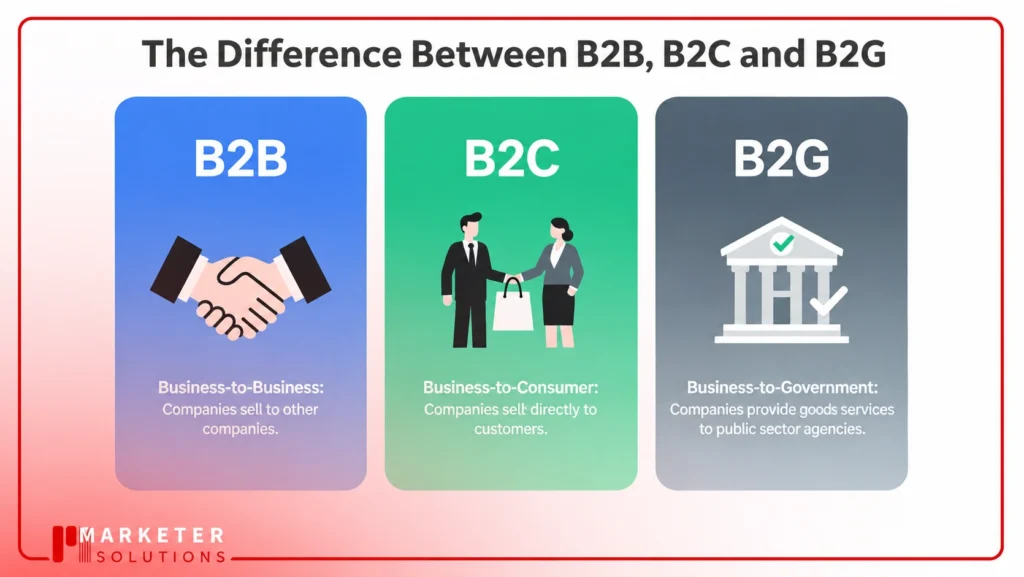
Knowing the difference between B2B, B2C, and B2G is the basis on which the entrepreneur builds his marketing and sales strategy to achieve success in the market, because understanding the nature of the audience and how each segment makes a purchasing decision is what distinguishes leading companies. In this article, we will review the fundamental differences between the three models and how they help Marketer choose and apply the appropriate model for the business activity. What is the B2B model? B2B refers to business-to-business transactions, where one company provides a product or service that another company needs to manufacture its products or facilitate its business. This model is characterized by a long sales cycle, often ranging between 45 and 90 days, because the purchase decision goes through multiple stages that begin with evaluation and end with negotiations and decision-making. The B2B business model relies on ROI and logic, which requires precise marketing content such as case studies to convince the decision maker. So, it depends The best digital marketing company in Saudi Arabia We provide specialized marketing strategies and professional content to build trust and support companies in making purchasing decisions. What is the B2C model? The B2C model is the most common at the present time, and in this model a direct selling strategy is adopted from the company to the consuming public. In this type, the duration of the sale may be short and not exceed a few minutes, as the transaction between the consumer and the company is completed quickly, because the consumer environment requires an intense presence on Social media platforms Focusing on building brand loyalty by providing immediate service and a distinctive experience, which is what Marketer offers to its customers. What is the B2G model? The B2G model is considered the pinnacle of investment and contracts, as the company deals directly with government agencies and ministries. This type of model requires institutional maturity capable of meeting the requirements. Government bodiesMostly, transactions take place through official platforms, so the question: What does B2G mean? can simply be answered. It is marketing directed to the government sector that does not depend on advertisements, but rather on building a strong reputation for the brand and presenting financial and technical offers that comply with the conditions and specifications of government agencies. The difference between b2b, b2c and b2g To make it easier for companies to know the difference between B2B, B2C, and B2G, we at Marketer have prepared a table showing these differences according to statistics: Comparison b2b model b2c model b2g model Target groups Factories and companies Individuals Government sector Sales cycle Long months and weeks Short moments or minutes Very long tenders Purchase motive Rational Emotional Standards and efficiency Transaction value High Low Very high Marketing channels Email or linkedin Tik Tok or Facebook Supported platforms and exhibitions Advantages and disadvantages of each business model After clarifying the difference between B2B, B2C and B2G, we can highlight the advantages and disadvantages of each model before using it, which are as follows: B2B model It is characterized by long strategic relationships and fairly stable income from large deals, but it has the disadvantage of a long collection period and the difficulty of convincing the consumer to buy. B2C model It is characterized by a fan base and large financial liquidity, but its drawback is the intense competition on price between companies and low customer loyalty. B2G model It secures huge contracts awarded to companies with a good reputation in the markets, but it has the disadvantage of requiring many complex legal procedures that may face delays in disbursing payments. The most important differences between B2B, B2C and B2G The difference between B2B, B2C, and B2G can be explained in how decisions are made, and that is what we will explain in the following points: B2B: Needs the participation of a large team in the evaluation process. B2C: Needs individual or group consultation. B2G: Subject to a formal committee called tenders. It must be noted that Marketer will help you understand how to choose the appropriate model in accordance with the objectives of your business, by providing digital marketing consulting Professionalism contributes to reducing costs, improving the efficiency of strategies, and increasing the return on investment. When do you choose a B2B, B2C or B2G model? The process of choosing the best model depends on the resources and nature of the company’s products. If, for example, you provide custom software for factories, then ‘B2B’ is the best, but if you sell consumer products, then ‘B2C’ is the most appropriate, and if the company has great technical expertise or experience in digital transformation, then ‘B2G’ is the best to achieve a higher profit, and here lies Marketer’s role in providing consultations that help companies take the most appropriate direction according to a careful study of competitors and the market. Examples of B2B, B2C, and B2G companies After clarifying the difference between B2B, B2C, and B2G, we can give a practical example of how companies use different models in the global market through the following examples: B2B: Marketer company when it provides its marketing services to startups, small and large companies. B2C: Such as the HungerStation application that deals directly with individuals to meet their daily needs. B2G: Such as large contracting companies that implement huge NEOM projects. How to build a B2B brand To build a brand in the B2B sector, you must focus on strength and cognitive authority, as the company must appear as an expert in the field by publishing its content and participating in seminars, because building a corporate brand does not depend only on visual attraction, but on proving its ability to solve all problems and provide continuous and distinguished technical support, which is what we at Marketer help you achieve through carefully thought-out content strategies. How to find and target an audience After knowing the difference between B2B, B2C, and B2G, we can focus on how to search and start targeting the audience
Examples of product life cycle stages
Examples of the stages of the product life cycle provide business owners with a clear vision of how to develop their products in the target market, starting from their launch until they reach the decline stage. Understanding these stages is essential for building promotional plans that can keep pace with changes in customer behavior and needs. At our company Marketer Solutions, we ensure that the product life cycle is carefully analyzed to develop plans that suit each stage, and this in turn helps your brand to exploit the available opportunities and enhance its ability to excel in a rapidly changing market. What is the product life cycle? It is the path that any product takes, starting from a mere idea, passing through design, then development, production, marketing, and sale, until the end of its economic life. The life cycle of products in the traditional model consists of 4 basic stages, but some have expanded this analysis to include 7 sub-stages that begin with developing the idea and end with withdrawal from the market. Examples of product life cycle stages Examples of product life cycle stages help illustrate how to manage products in a practical and effective manner. From this standpoint, we are keen to cooperate with The best digital marketing company in the Kingdom It helps companies move from theoretical explanation to successful practical application through the following steps and applications: Energy drinks It entered the markets as a new category with marketing focusing on the idea of instant energy, and after that it witnessed significant growth with the entry of some international and local brands to reach the stage of maturity to this day, characterized by a variety of assortments and flavors and competing for market share. Smart watches It entered the market as an experimental product with limited functionality and use, and then moved into a strong growth phase as large companies and technological developers approached it. Today, it is in an early maturity phase with many companies focusing on differentiating their products with other additional features. Electric cars It was launched on the market with very high prices and a limited shipping infrastructure. Despite this, it is in a phase of rapid growth now with the presence of new manufacturing companies, which has resulted in a gradual decrease in price and increased demand for it. The concept of product lifecycle management (PLM) It is a system that establishments rely on to manage data and processes related to the various stages of a product’s life by digitizing and organizing them. Engineering, sales, marketing, suppliers, and customer service departments participate in it to consolidate resources and facilitate access to information; This provides an accurate and clear vision How to market a new product in the market With the lowest percentage of errors and the highest quality of decision-making. Product life cycle in product development and marketing A precise understanding of all stages of the product life cycle contributes to the formulation of practical plans for the efficient development and marketing of goods and services. This awareness helps facility owners direct… Ways to market products online To suit market requirements in every period of growth or growth, which reduces risks and ensures achieving the highest return on investment as follows In Development: Assists in making informed decisions regarding features, design and production processes, ensuring alignment with market needs. In MarketingThe product life cycle is considered a map that guides promotional efforts and various pricing mechanisms. In the introduction stage, a lot is invested in advertising, while efforts in the growth and maturity stages turn to building brand loyalty. Determining what stage your product is in the market is the key to choosing the right marketing strategy! Contact our marketing consultants now to analyze your product positioning and formulate a clear growth plan that achieves the highest returns. Get marketing advice for your product via WhatsApp Examples of product life cycle We present in Marketer Solutions business Examples of the product life cycle in marketing in different sectors such as technology are as follows: DVD players They started as high-cost luxury products and then spread to homes and cars in the growth and maturity stages before entering a clear decline with the launch of live streaming services. Smartphones It initially went through a limited introduction phase as a result of its high prices, then after that it entered a rapid growth phase, which led to a decline in its prices and the emergence of installment offers, until it then reached a maturity phase characterized by great spread and intense competition among many companies. Tablet computers It initially witnessed huge demand as one of the light alternatives to laptop computers and went through a fairly rapid growth and maturity stage, but recently it began to face a slowdown in sales, especially with the improvement in the performance of large smartphones. The importance of studying the product life cycle The importance of studying the product life cycle is represented in many aspects as follows: Strategic planning: It helps brands make correct decisions about product development and resource allocation according to the stage they are going through. Securing resources: by directing them efficiently throughout the product life cycle, ensuring the greatest return on investment. Managing potential risks and market changes to enable brands and companies to proactively adapt to them. Benefits of product life cycle management The benefits of effectively managing the basic 7 stages of the product life cycle are evident in several places: Increasing profitability: by extending profit periods for as long as possible through proper planning for each stage. Giving the company a competitive advantage: the ability to stay ahead of its competitors by anticipating market trends and consumer preferences. Increase customer loyalty: and keep them for a long time by constantly improving products and offering them renewed versions. Product life cycle strategies Product life cycle strategies vary depending on the industry and the nature of the product itself; Technological products require updates and responsiveness that are completely different from