
Marketing emerging projects needs a different approach because the new project often lacks budget, customers, and expansion. Therefore, success begins with knowing the problem, understanding the customer’s needs, and formulating the valuable marketing message before determining the final budget. Here, Marketer stands out because it helps develop marketing strategies that suit the Saudi market and helps you choose the appropriate marketing channels, acquire new customers, and achieve record results that help you grow and expand without depleting the budget.
Marketing emerging projects
Developing a marketing plan for emerging projects or marketing emerging companies does not mean publishing random content or advertisements. Rather, it must begin with understanding the market and its needs and understanding the needs of customers so that they can be transformed from interested customers into continuing customers. For this, the company needs to learn from interviews and experiences, and modify the product, marketing message or channel so that it suits the nature of the target group. This is why there is no single successful marketing method for all emerging projects.
How do you market a startup project in Saudi Arabia with a limited budget?
can put digital marketing strategies To market emerging projects with a specific budget when directing resources to the customers most likely to buy instead of trying to reach all customers, so start with a single marketing message, a specific problem, and a channel whose results can be measured, then gradually expand the ads after real indicators of demand appear. In the following steps we will explain how to build a marketing plan for an emerging project in a practical way:
Understand your potential customer’s problem
Conduct short interviews with customers to learn about their problems, current solutions, and the amount paid to address them. Do not make the interview for the purpose of selling, but rather use their answers to be able to formulate a marketing message that has priorities.
Post content that demonstrates expertise
Do Content marketing By creating articles and videos that answer frequently asked customer questions, and explain how to solve this problem with an invitation to try the product, request a consultation, or register.
Test a single landing page ad
Run a test ad with one goal and a landing page that explains the problem and its solution, stop weak messages that do not address the audience, and do not raise the campaign budget before understanding the reason for the conversion.
Get customer reviews
After providing a good customer experience, get an honest review or nominate someone who needs a solution, while providing an appropriate incentive and taking care not to ask for inauthentic reviews.
Verify the market and Product-Market Fit before marketing expansion
Before expanding the marketing of emerging projects or increasing the budget, you must first ensure that the product solves a real problem and that there is a large segment of customers who are willing to pay for its value and use it. This means Product Market Fit: There is a practical fit between the product and market needs, not just audience appeal.
Therefore, testable hypotheses must be identified: What is the current alternative? What’s the problem? Showing a prototype to a limited number of audiences, monitoring frequency of use, demand and purchase, and preparing to nominate the new product. If the customer problem is identified but the order or purchase is not completed, then the purchasing experience is simplified or prices and benefits are modified to suit their needs.
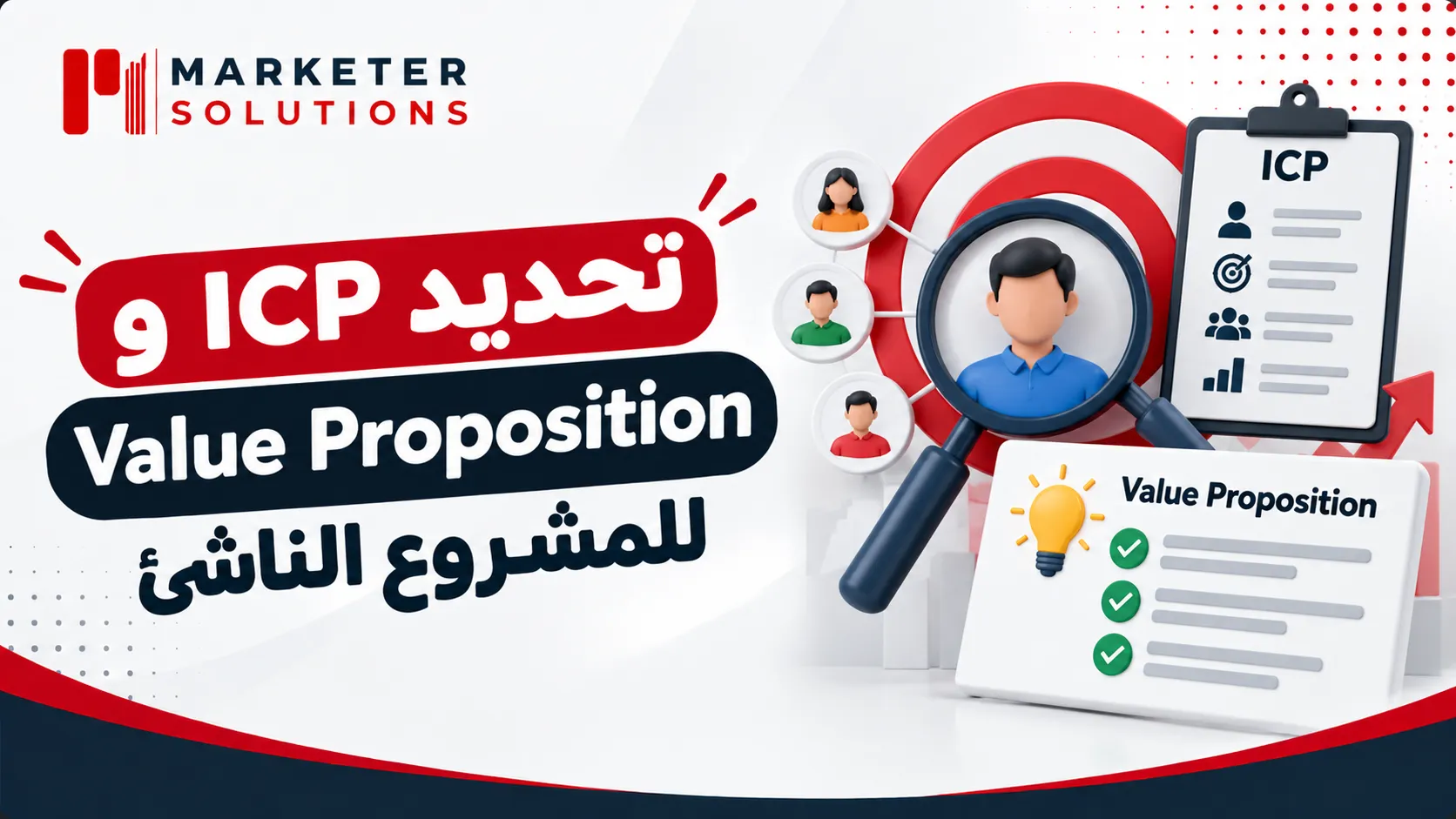
Determine the ICP and Value Proposition of the startup project
Before launching a marketing campaign, the startup needs to identify the target customer and understand the problem it wants to solve. This will help build accurate marketing messages and direct resources to the segment most interested in the products.
Identify your ideal ICP client
Identifying the ideal customer involves studying their characteristics, needs, behavior and purchasing power, focusing on the segment that has a problem that the offered product can solve rather than targeting the entire market with the same message.
Formulating the value proposition
After identifying the ideal customer, the value that the project offers and what makes him choose him instead of competitors is clarified. Therefore, it is preferable for the marketing message to be direct and brief, explaining the problem that the product solves and the benefit that the customer obtains.
Building Go-To-Market Strategy according to the project model
After identifying the customer, comes the stage of developing a Go-To-Market entry strategy, the essence of Startup Marketing, because it links the marketing channels and the buying and selling mechanism together, where it determines how the product reaches customers and attempts to attract their interest towards sales. The strategy varies according to the nature of the product, the size of the market, the purchasing cycle, and the available resources. Below is a detailed explanation:
Selection of access channels
The project identifies the most appropriate channels to reach the target audience, whether through social media platforms or… Search engine optimization Google, paid ads, or partnerships. It is preferable to start with a small number of channels and test their effectiveness before expanding expenses.
Define the sales journey
The strategy explains the stages that the customer goes through from learning about the product until completing the purchase process, specifying the appropriate marketing message for each stage. This includes the method of acquiring new customers, the mechanism for converting them, and the method of follow-up after completing the purchase.
Measuring results and development
The market entry strategy does not end immediately after launching the project. Rather, it needs to follow up and evaluate performance indicators such as conversion rate, customer acquisition cost, and sales value. These results help to discover the most effective marketing channels and messages to make the necessary adjustments.
Choosing the appropriate customer acquisition channels for the startup
Within the framework of developing marketing plans for emerging projects, the marketing channel must be chosen according to customer behavior, the cost of access, and the nature of the purchase. For example, Google search engines help with clear demand, while social media platforms are more suitable for explanation and community building. The following are the most prominent customer acquisition channels:
- Content and SEO: It is most suitable for requests that start with a search, so it is measured by the number of visits and conversion rate.
- Paid Ads: Fit for testing ad segments and messages quickly, measured by customer acquisition cost and conversion quality.
- Partnerships: Fit to reach existing audience, measured by engagement rate and referrals.
- Mail and messaging: Used when re-activating interested customers, measured by click-through rate, open and response rate.
Therefore, it is preferable to start with only two channels under testing, and this is where it helps you Marketer Company To link the channel to the marketing goal, instead of distributing the budget to useless platforms and channels.
Plan to launch the emerging project and build the first customer base
Marketing startup projects at launch requires a plan that precedes the advertising process, because attracting visits before preparing the product and customer service may cause negative results, so the project launch phase is divided into three stages:
Before launch
A waiting list is gathered, content explaining the problem is published, the marketing message is tested, and then a landing page, registration form, and answers to questions about price, support, and privacy are prepared.
During launch
Deliver an offer with a clear concept, use product experience and customer stories rather than making generic promises, then monitor the source of traffic, sign-ups, questions and inquiries from customers while accelerating the response.
After launch
Communicate with customers who started the experiment but did not complete it, ask for their feedback and comments, fix recurring problems or obstacles, and avoid considering the number of followers as a criterion for success because the real criterion is measured by active customers.
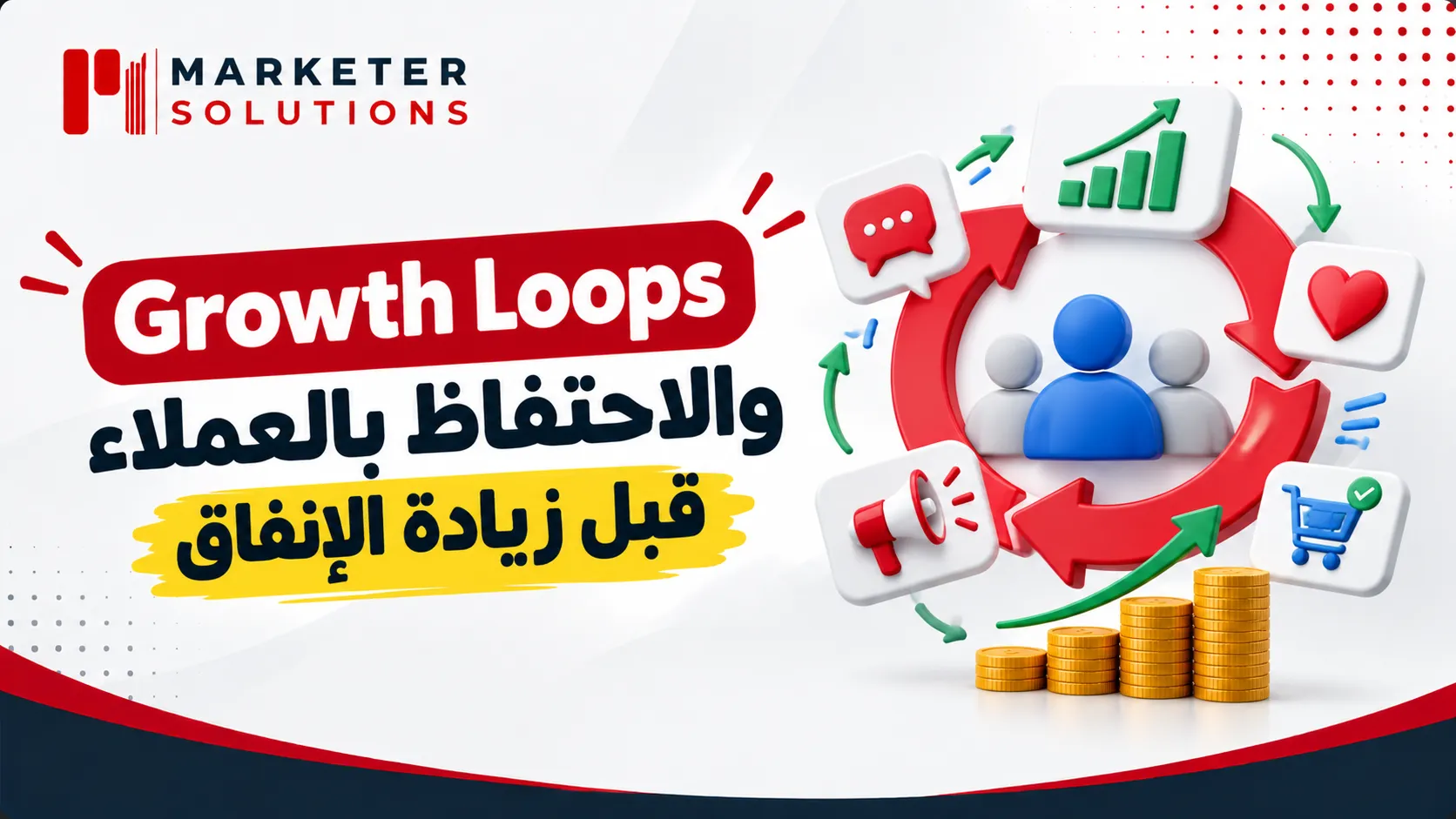
Growth Loops and retain customers before overspending
Growth Marketing relies on experiences that link the product, marketing, and data, while Growth Loops works to create a cycle that helps the customer’s use or participation gain new customers, such as inviting another colleague to use a shared tool. Also, increasing spending on advertising will not address the problem of customer retention, especially if the customer leaves quickly, so it is necessary to examine the difficulty of using the product and the accuracy and clarity of the value, then improve the marketing messages, guide to use, and support, because the quality of retention is measured by repeat use and purchase.
Measure CAC, LTV, Retention, and 90-day growth plan
Marketing emerging projects depends on monitoring indicators that help evaluate the efficiency of growth and spending, most notably the following:
- CAC: Measures customer acquisition cost.
- LTV: Shows the expected value from customer acquisition.
- Rotation: reveals how persistent customers are.
It must be noted that these indicators help guide Startup Growth decisions, which Marketer relies on to analyze performance and improve marketing campaigns.
Build a 90-day growth plan
The growth plan can be divided into three basic stages, which we summarize as follows:
- Implementing the initial 30-day plan: We set goals and indicators and test marketing messages and channels.
- Optimize performance from 31 to 60 days: Results are analyzed and marketing channels and experiences that generate better response are optimized.
- Growth expansion from 61 to 90 days: Successful trials are expanded and approved results are reviewed in preparation for the next growth stages.
Frequently asked questions
What is the best marketing channel for a startup with a specific budget?
There is no marketing channel that suits all projects. The choice depends on where the customer is located and the nature of the purchasing decision, so start with a measurable marketing channel such as social media platforms or Google search, then test the two messages with one goal. Keep the channel that attracts more qualified customers and does not rely on abstract interaction.
When does a startup start running ads?
Ads can be run after preparing a clear offer, a landing page, and a stable and clear payment or registration experience, and not once you have the idea. Start with a test budget that collects data and determines success indicators such as the conversion rate, and addresses objections and criticism or the message before expanding spending. Then expand the budget gradually after tangible and measurable results appear during the first test.
What is the difference between CAC and LTV?
CAC represents the average amount spent on a project to acquire a new customer and usually includes sales and marketing during a specific period, while LTV is the value expected from the customer and the period of his reliance on the project. The two indicators are compared to determine whether the growth is profitable or not, taking into account the operating cost and profit margin.
Conclusion
In conclusion, marketing for emerging projects succeeds when you start by understanding the target audience and its needs and testing the suitability of the product for the market, then moving to a measurable channel with continuous improvement to retain customers, so you do not initially need large spending, but rather clear hypotheses and numbers that help you make a decision, and with the experience of Marketer Company, the marketing plan can be transformed into practical steps that support the acquisition of new customers and sustainable growth.