
The answer to the question, “What is STP in marketing,” is that it is the framework for understanding how to build a successful marketing strategy that goes beyond just traditional advertising to reach the target audience immediately, as at the present time it is no longer enough to provide a single product, but rather it is necessary to know to whom the product is being offered and how to reach and show the brand in a place that cannot be reached, and this is what can be achieved through cooperation with Marketer, the leading company in creating marketing solutions that achieve exceptional profits for its customers.
What is stp in marketing
The STP model is an abbreviation for three main processes: segmentation, targeting, and positioning. The goal of this model is to direct marketing efforts to focus on the target audience, ensuring that the message reaches the right person at the right time. Therefore, the question of what is STP in marketing can be answered as digital marketing strategies Effectively, it helps companies identify the most profitable category and focus on it instead of wasting resources and budget on campaigns that do not achieve results
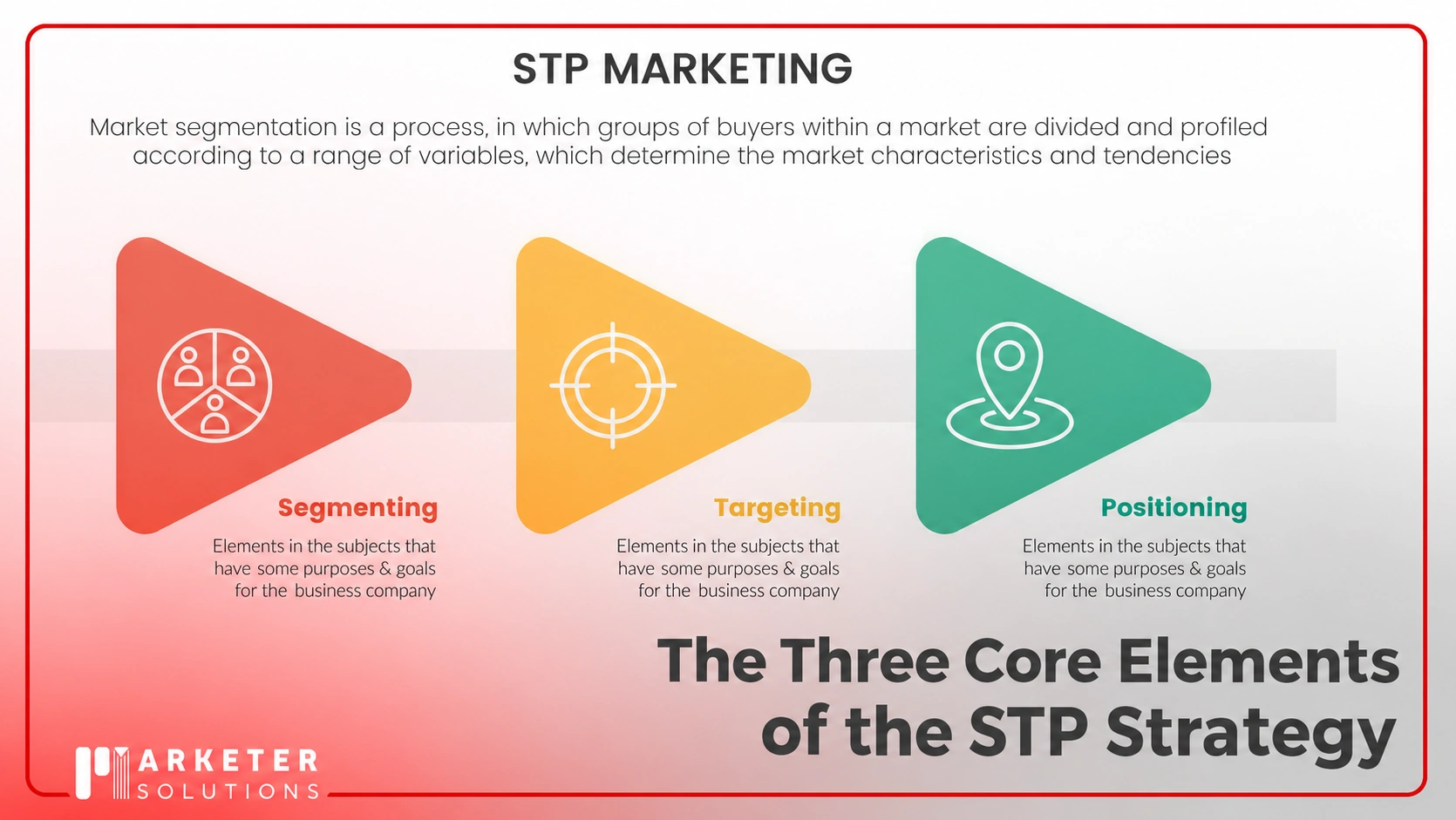
The three basic elements of an STP strategy
The STP strategy depends on three basic elements, which we will explain in detail in the following points:
- Segmentation: The process of dividing a market into small categories that share specific demographic, geographic, and psychographic characteristics.
- Targeting: Determine the most profitable segment to focus on according to the size of the market and the company’s ability to reach it.
- Positioning: It aims to draw a clear mental image of the brand and product in the minds of customers.
Step-by-step guide to implementing STP
After knowing the answer to the question: What is meant by STP?, we will discuss how this model can be applied successfully and with high accuracy, and this is what we are good at at Marketer Company, where this is done as follows:
- Defining the Market: Start by understanding the size of the market the company can serve.
- Applying segmentation criteria: Using behavioral, demographic, and geographic data to classify categories.
- Evaluating the attractiveness of categories: measuring the profitability of each category and its marketing cost.
- Choosing the segment or category: Determine the category and segment that achieves the highest return on investment.
- Develop a positioning strategy: to determine the competitive advantage that makes the customer choose one brand over another.
- Developing the marketing mix: The elements of the marketing mix, product, price, place, and promotion, must be consistent with the target segment and group.
A practical example of an STP strategy
To illustrate how this strategy works, we will shed light on how this is applied in practice to Marketer The best digital marketing company in Jeddah For marketing services:
- Division: Marketer divides the market into emerging, medium and large companies, taking into account the nature and size of the business activity and the marketing objective.
- Targeting: Focuses on targeting small and medium-sized companies that want to enhance their digital presence and achieve sustainable growth.
- Positioning: Marketer is positioned as a strategic partner that relies on collecting and analyzing data and developing customized strategies that help transform the results of the marketing campaign into measurable results.
Steps to apply the STP strategy
After learning what STP is in marketing, we can focus on that this strategy is implemented according to a set of clear steps to ensure that resources are not wasted, and these steps are as follows:
- Data Collection: Using state-of-the-art analytics tools to understand current consumer behavior.
- Competitor analysis: knowing where the competitor stands and exploiting the vacant space.
- Defining value: formulating a distinctive and unique marketing message that meets the needs of target groups.
Common errors in STP implementation
We answered the question: What is STP in marketing? As a result, we can realize that not implementing this strategy accurately may cost the organization its entire marketing budget. The most common mistakes when implementing it are the following:
- Broad targeting: Trying to satisfy all groups leads to their dissatisfaction.
- Ignoring behavioral data: Relying only on data such as age and gender without understanding the reason for the purchase.
- Weak positioning: lack of clarity in the competitive advantage that makes the customer compare you with other competitors on the basis of price.
Is STP a foundation for sustainable business success?
Yes, certainly, the STP model is considered the cornerstone for any client who desires sustainability and growth in the market. By defining what is STP in marketing in depth, the company can build a strong and solid relationship with its customers, as the customer feels that the product has been designed to meet his needs, which increases his loyalty to the brand and reduces the cost of acquiring new customers. Therefore, Marketer believes that sustainability begins with a good and deep understanding of the target groups before launching the campaign.
The importance of the STP model in marketing
The importance of using the STP model in marketing lies in its ability to improve spending efficiency and increase the profit conversion rate. We can focus on some of the reasons that highlight its importance as follows:
- Personalization: Allows personalized messages to be sent to customers to increase the value of their interaction.
- Product Development: Helps understand gaps in the market to develop a product that meets unsatisfied needs.
- Competitive distinction: It helps the brand find a distinctive position in the market away from price competition.
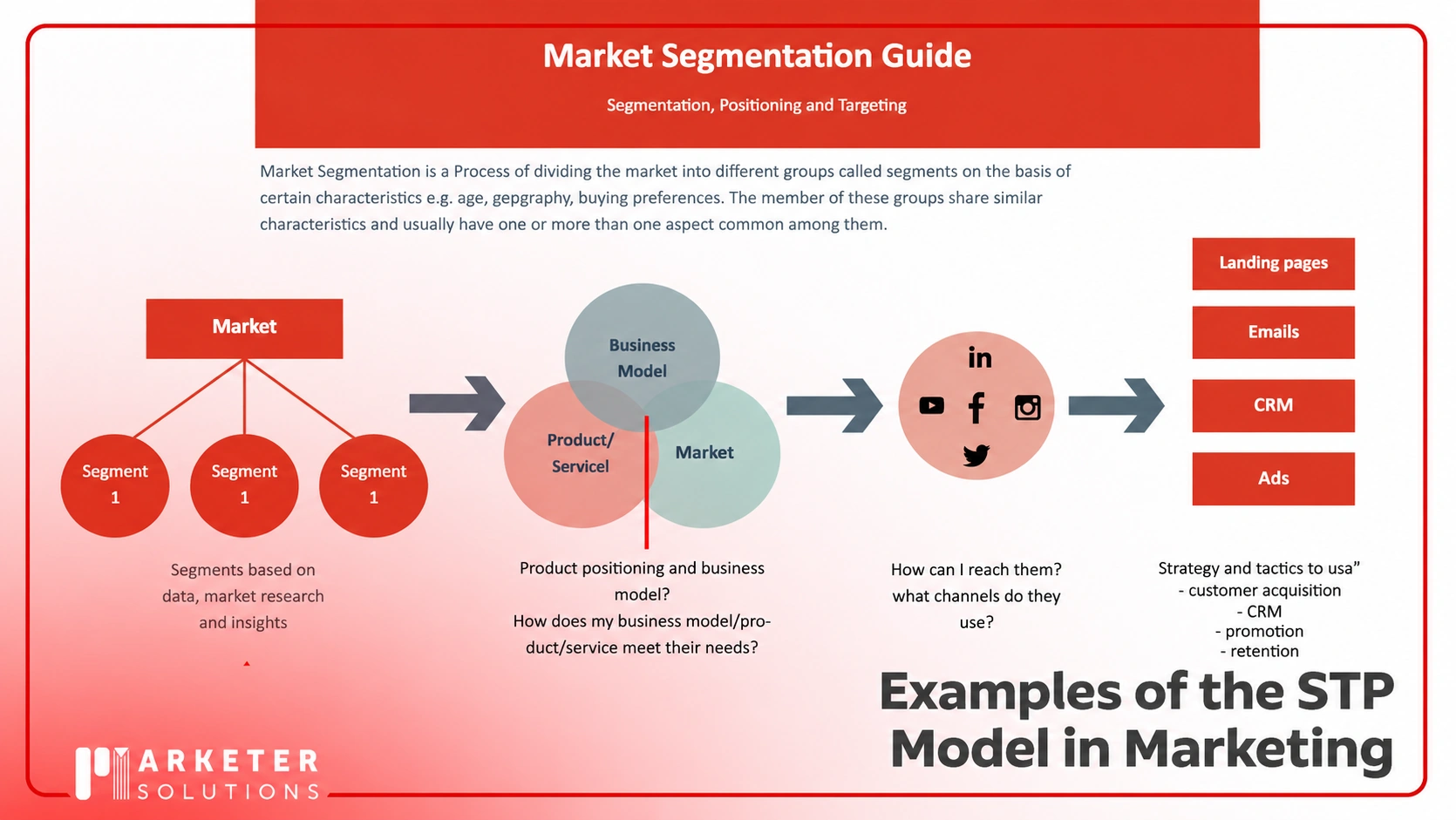
Examples of the STP model in marketing
After we learned about what STP is in marketing, we notice that it is applied in international companies such as Apple as a result of its importance in targeting categories accurately and helping the brand differentiate itself from competitors. This is why many international companies rely on it to help them increase rates of return on investment and increase profitability, and therefore Marketer has emerged as one of the best marketing companies that helps develop an STP model for an organization that meets its needs.
The difference between STP and 4Ps in marketing
It is difficult for some people to differentiate between stp and 4ps In marketing, but the difference between them is clear and is represented in the following table:
| Comparison | stp model | 4Ps model |
| Focus | Focuses on the customer and his choices | Focuses on the product and ways to sell it |
| Nature | A strategy based on thinking and planning | Tactical strategy based on action and execution |
| The role | It defines who we deal with and what we are known for | Determines how to deliver the product to the target group |
Don’t waste your budget on random ads, send us your field of work via WhatsApp, and we will help you segment your market and choose the most appropriate category for your project immediately!
Chat with a marketing expert via WhatsApp
How does the STP model help marketing campaigns succeed?
The STP model contributes to raising the effectiveness of the marketing campaign by directing the advertising message to those interested, so when you realize what is the STP system? By applying it, the cost per click will decrease and the rate of return on spending will increase significantly. This is why at Marketer we use the STP model as a map that shows the path of the digital marketing campaign, which ensures that customers rank ahead in Google search engines and reach the top.
Frequently asked questions
Is the STP model suitable for enterprises and small businesses?
Yes, it has a more important role in small companies because they have a limited budget, and therefore relying on this model will give them the ability to focus their resources on the most profitable segment, which will ensure faster growth at a lower cost.
When should a company reevaluate its STP strategy?
The strategy is re-evaluated when new competitors enter, when there are changes in customer behavior, or when a new product is launched, as constant updating ensures a connection between the brand and the needs of the market.
What is the difference between behavioral segmentation and demographic segmentation?
Demographic segmentation focuses on the customer’s age, gender, and income, while behavioral segmentation focuses on what the customer does, such as the number of times he buys the product, his level of loyalty to the brand, and how and what he uses the product, and is often more accurate in the purchase prediction process.
In conclusion, knowing the answer to what is STP in marketing is not an option, but rather a necessity for every company that desires leadership. We have reviewed how important it is for companies in clarifying customer needs, so if you want to apply it with high professionalism and be at the top of search engines, you must rely on Marketer because it works to implement this strategy to achieve tangible successes and record numbers.