
Software marketing puts products in front of customers who are interested in using and purchasing them, but achieving that result is not only related to advertising the program and its benefits and advantages, because the customer today compares different solutions and searches for the best product that meets his needs, and provides him with real value that he can touch the impact of in his work and daily life, and this is what Marketer Solutions works to highlight in the software marketing process, as it is an integrated strategy that demonstrates the program’s strengths, increases the brand’s digital visibility, and attracts potential customers to it in order to achieve growth and sales goals.
How to market a software company or SaaS product in Saudi Arabia?
The process of marketing software companies goes through a series of different stages, starting with identifying the appropriate customer and ending with measuring the indicators they have achieved Advertising campaigns, as follows:
- Identify the appropriate customer and people involved in the purchasing decision.
- Building marketing messages that help the customer understand the benefits and value of the program.
- Search engine optimization for problem and solution keywords and comparisons.
- Producing content tailored to the business sector and using LinkedIn to generate opportunities.
- Offering advertising campaigns that include a free trial or demo of the software.
- Choosing whether the customer will try out and subscribe to the software product themselves or will require contacting the sales team and booking a demo before making a purchasing decision.
- Measuring various financial indicators that will determine the sustainability of growth.
Determine the ICP and Buying Committee for the software product
Before spending money on marketing, the software company must know… Web development The customer who deserves to be targeted, and who can participate in making the decision to purchase the program within that company.
Identify your ideal ICP client
There are some steps that help you determine the ideal customer for your software product, which are as follows:
- Analyze the best current customers and extract common points between them.
- Identify general characteristics such as sector, company size, and location.
- Researching the challenges and purchase incentives that make the customer want to find an actual solution to his problem.
- Knowing the tools and systems that the client is currently using.
- Involving the sales and customer service team in identifying the ideal customer.
- Review your ideal client’s profile periodically because the market is constantly changing.
Who participates in the purchasing decision of the software product?
The purchasing decision for B2B SaaS products is rarely made by one individual. Rather, it is shared by several parties within the company, each with a different interest in the product, such as:
- End user: who is interested in ease of using the program and saving time in his daily work.
- Economic buyer: who is concerned with cost and return on investment.
- Technical Buyer: Someone who evaluates the security, integrity, and technical architecture of the software.
- Internal supporter: An employee who is convinced of the product and can defend it to the rest of management.
- The final budget holder: the one who signs the financial approval to purchase the software product.
In fact, understanding these roles helps design various marketing messages for each individual instead of relying on one general message that cannot completely convince anyone.
Build a positioning and marketing message that explains the value of the program
Positioning is defined as the mental positioning or impression that a company or product has on the customer’s mind, through which the brand can be distinguished from competitors.
Steps to build positioning of a software product
Positioning is built by following a specific strategy, which is as follows:
- Analyze competitors and study their strengths, weaknesses, and marketing messages.
- Extracting all possible competitive advantages in the product itself, its complementary service, or the support team.
- Weighing these advantages according to 3 criteria: their importance to the buyer, the intensity of competition for them, and the company’s ability to provide them continuously.
- Choose a framework that brings together a set of features into one central idea.
- Installing this frame or mental location in all marketing messages for a long time.
Elements of the internal marketing message
The internal mental positioning statement consists of 4 basic elements that explain how the company competes in the target market as follows:
- The target segment of the product.
- Product or brand name.
- The field and category in which you compete.
- The most prominent benefit around which the product is positioned.
SEO for software: problem words, solutions and comparisons
Software’s success depends on it SEO To understand the customer journey, which passes through 3 stages and has its own keywords that must be targeted with content tailored to them.
Types of keywords in SaaS marketing
The following table shows the keywords that are used in SaaS Marketing, which are as follows:
| Floor type | Its purpose | Example |
| Problem words | Attract customers who have not yet discovered that this program is the solution. | How do I manage a sales team without using Excel? |
| Solution words | Attract customers looking for a straightforward solution. | The best customer relationship management software. |
| Comparative words | Attracting customers at the final decision-making stage. | Program X versus Program Y. |
| Brand words | Targeting customers who know the product and want to check it out. | The name of your company or product. |
Steps to build content for each type of words
You should build custom content for each type of keyword used in Software Marketing by:
- Start with educational articles that answer the problem questions before knowing the name of the solution.
- Create realistic and honest comparison pages between you and competitors that explain the differences between your product and their products without exaggeration.
- Link each article to your free trial or demo.
- Distribute the main keywords and the accompanying semantic words in the titles and paragraphs naturally.
The best SEO tools used in software marketing
SEO professionals use a set of distinctive tools to analyze keywords and monitor performance as follows:
- Google Search Console: To detect technical problems and follow up on the site’s performance.
- Semrush and Ahrefs: to analyze competitors’ strategies and backlinks.
- Google Keyword Planner: To know the search volume for target keywords.
- Google Analytics: To analyze visitor behavior and conversion rates.
Content Marketing and LinkedIn to generate B2B Software Leads
The customer needs content that gradually builds trust in your brand after arriving at your website through search, before requesting a demo or trial version, and this is exactly where both content and LinkedIn come into play together.
Effective content types in software marketing
There are some types of content that are useful and effective in SaaS marketing and they are as follows:
- Educational articles that explain how to solve the problem your target customer is facing.
- Case studies showing the results achieved by existing customers after using the product.
- Webinars with experts from the team or a group of clients participating.
- Comparative guides between solutions available in the market.
- A short video mentioning one feature of the product.
How to Use LinkedIn to Generate B2B Software Marketing?
You can make the most of LinkedIn B2B Software Marketing via the following:
- Publish content in the voice of the software product founders or team experts.
- Direct targeting of Buying Committee related job roles through sponsored ads.
- Use LinkedIn Sales Navigator to get in front of decision makers at companies that match your ICP.
- Share case studies and results with customers rather than talking about product benefits directly.
Google Ads, Demo and Free Trial to turn demand into sales opportunities
Paid ads speed up the reach of qualified target customers, but their true benefit is when they lead them to a direct and clear conversion step like a Free Trial or Demo.
Best Google Ads Campaigns for SaaS Businesses
Google Ads campaigns include a group of types suitable for software marketing as follows:
- Targeted search campaigns for solution words and direct comparison.
- Demand drive campaigns to display ads on Gmail and YouTube.
- Retargeting campaigns to visitors who have already viewed the product’s pricing or features page without requesting the offer.
- LinkedIn ads to target job roles at target companies.
Steps to design an effective Demo or Free Trial page
The Free Trial or Demo page must be specifically designed to remove the greatest possible obstacles in front of the target customer, as follows:
- Provide a short registration form that goes beyond just the basic fields.
- A clear explanation of what the customer will enjoy during the trial period.
- Display logos from existing clients or results numbers to build instant trust.
- Allows you to book a demo appointment directly without having to wait for an email response.
How to turn a request into a sales opportunity?
The request is converted into a sales opportunity by doing the following:
- Sending an immediate welcome message as soon as the customer registers for the free version.
- Design onboarding processes that lead customers to the first useful result or feature quickly.
- Follow up on the customer’s actual use of the product during the trial period through usage data.
- Communicate with the sales team in a timely manner if the customer shows any good signal to buy.
Availability marketer Solutions Google Ads and LinkedIn campaign management services for software companies in the Kingdom, from building a landing page to improving the conversion rate of the trial version to paid.
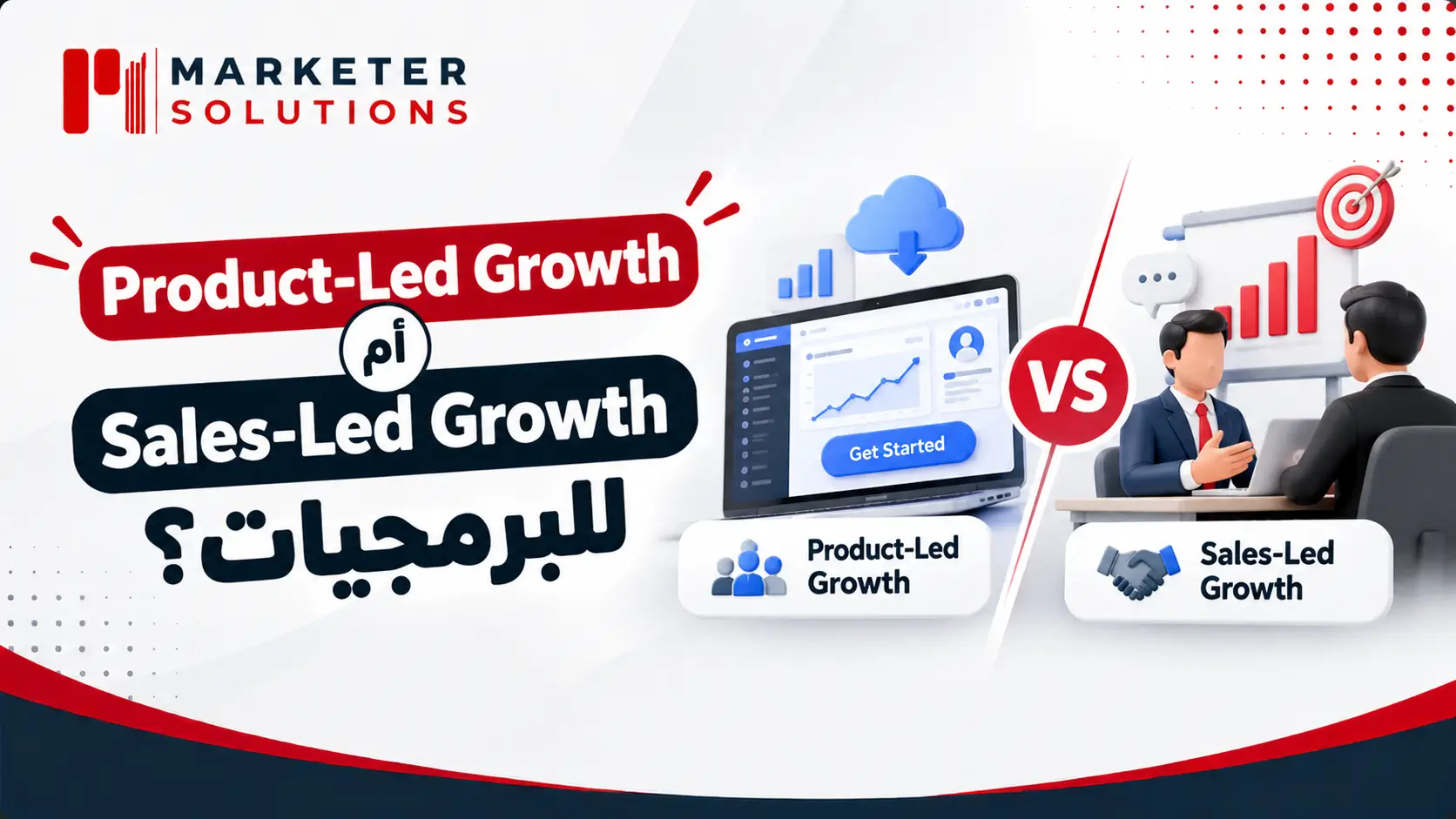
Product-Led Growth or Sales-Led Growth for software?
The best model for software company growth determines the shape of the marketing team, the nature of the content, and the design of the pricing page itself. The most notable differences between them are as follows:
| Comparison | Product-Led Growth | Sales-Led Growth |
| Relationship with the client | The customer experiences the product directly with the free version. | The customer speaks with the sales team before trying the product. |
| Suitable product type | A product that is simple to set up and quick to value. | A complex product that needs customization and integrations. |
| Sales cycle | short. | Longer and requires different approvals. |
| Transaction size | From small to medium. | From medium to large. |
| Sales team role | He intervenes after the client shows genuine interest. | Leads the purchasing process from start to finish. |
| Example | Design, collaboration or productivity tools. | Human resources planning systems or solutions directed to the large corporate sector. |
Measuring CAC, Trial-to-Paid, Churn, and LTV in Software Marketing
We rely on 4 main indicators that are supposed to be constantly monitored to determine whether the software marketing plan is actually working or just consuming the budget as follows:
Customer Acquisition Cost (CAC).
The customer acquisition cost is calculated by summing the various costs associated with marketing and sales, not just advertising, and for the entire duration of the cycle, not just one month, using a specific equation, which is CAC = (advertising cost + salaries + currencies + tools) ÷ number of new customers.
Conversion rate of trial to paid subscription
The Trial-to-Paid indicator measures the percentage of users who complete the trial and turn into paying customers, and a low percentage often indicates a poor onboarding experience or the customer is not getting the core value of the product from the free trial.
Churn rate
Churn Rate expresses the percentage of customers who have canceled their subscription in a certain period of time, and a high rate means that this product does not provide continuous benefit to the customer or that its pricing is not appropriate for the amount of benefit provided by it.
Lifetime customer value (LTV) and its relationship to CAC
The customer lifetime value is calculated = average revenue per customer x gross profit margin ÷ over the customer loss rate. The golden rule for the LTV to CAC ratio is 3:1 as the minimum. If it is less than this, it means that the company is paying too much to acquire customers. If it exceeds 5:1, there may be an opportunity to grow with a larger promotional budget.
Frequently asked questions
What is software marketing?
It is a set of activities that are used to attract potential customers to a service or software product and persuade them to try it and subscribe to it. It differs from marketing regular products in that the purchasing decision is mostly collective, and its role is to transform into longer actual work and the value is built gradually through the content and the free trial before the actual subscription.
What is the best LTV to CAC ratio for a SaaS company?
The lowest known healthy ratio is 3:1, which means that the value of a customer over a lifetime must be at least 3 times the cost of acquiring him. If it falls below this, companies spend a lot on marketing, and if it exceeds only 5:1, there is an opportunity to safely expand marketing spending.
How to market a new SaaS product in Saudi Arabia?
You should start by identifying the ideal customer and the individuals involved in the purchasing decision, then build a clear mental website, produce content that includes the words “problem and solution,” use Google Ads and LinkedIn to generate trial requests, and constantly measure the customer’s lifetime value and acquisition cost to accurately adjust the budget.
Best channel to generate B2B Software Leads?
There is no single channel that can be used alone to generate B2B Software Leads. Search engines attract customers looking for a solution, LinkedIn reaches decision makers, while Google Ads accelerates access to already qualified customers. Combining these channels with compelling content can deliver the best B2B Software Lead results possible.
Conclusion
In the end, you can transform the capabilities of your program into a value that the customer realizes and understands well, and there is a real reason to choose and buy it. The success of the software marketing process is linked to the ability of brands to communicate with the right audience, present the product clearly, and build confidence that supports their decision to buy. With Marketer Solutions, you can develop a distinct strategy that gives your program a stronger presence and higher opportunities for growth in a highly competitive market.